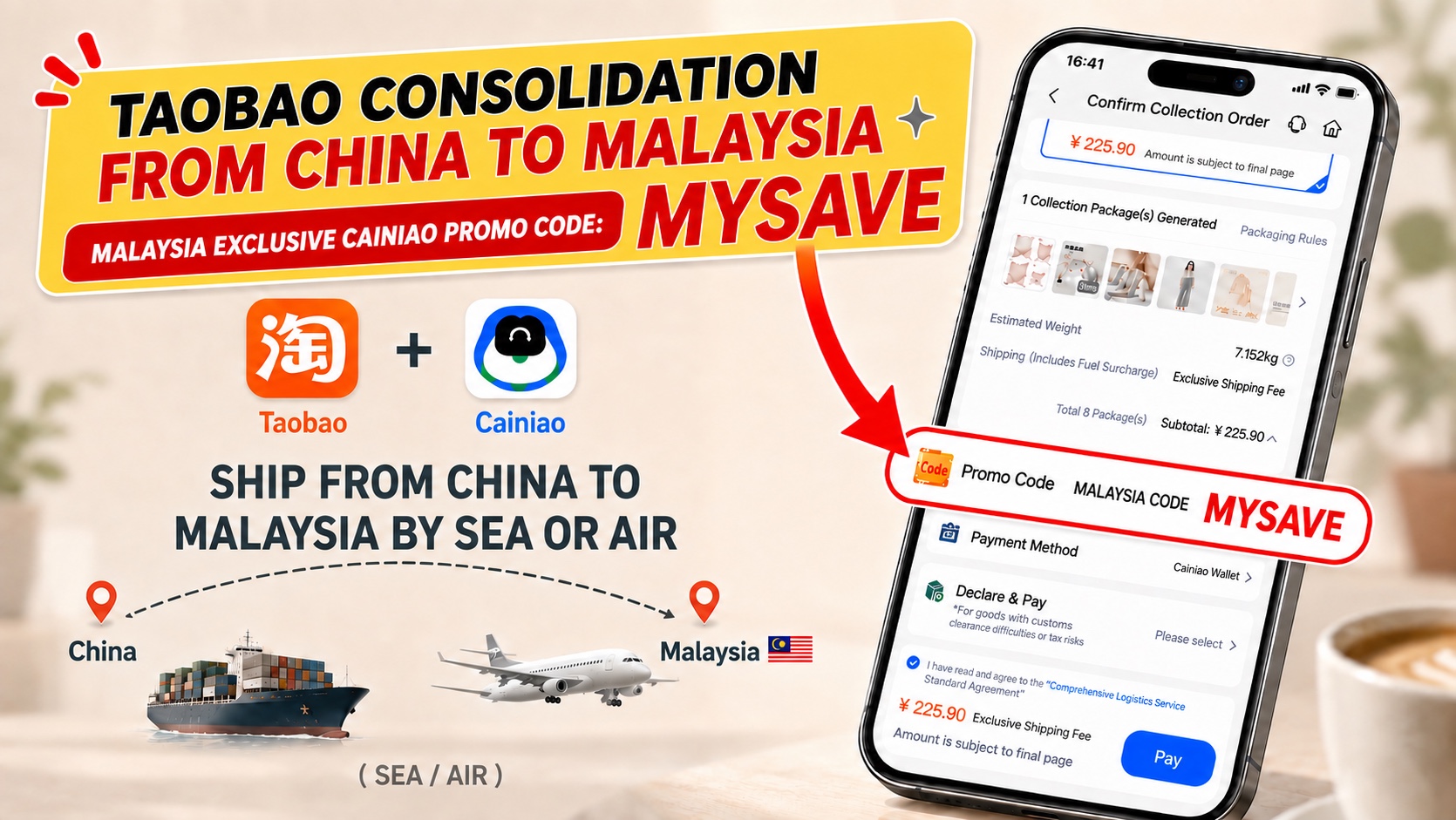
Budget Before You Consolidate for Malaysia’s Double 11: Managing Volumetric Weight and Timing in West and East Malaysia
Before Double 11, the figures worth checking are not limited to the total value of your purchases. You also need the outer-carton dimensions measured by the warehouse, the chargeable weight for each route, and the free-storage time remaining on your earliest parcel.

Before Double 11, the easiest items to underestimate are often not expensive products, but shoes in boxes, storage items, plush toys and gift sets with bulky retail packaging. A product listing that says 6kg does not mean a consolidated carton will necessarily be charged as 6kg. Waiting for every parcel to arrive may not be cheaper than sending two batches either, because the storage clock keeps running.
The shipping-cost estimates below use the 22 July 2026 Malaysia rate card as their baseline, while warehouse timing follows the storage rules effective from 1 October 2026.
Check the destination before calculating volumetric weight
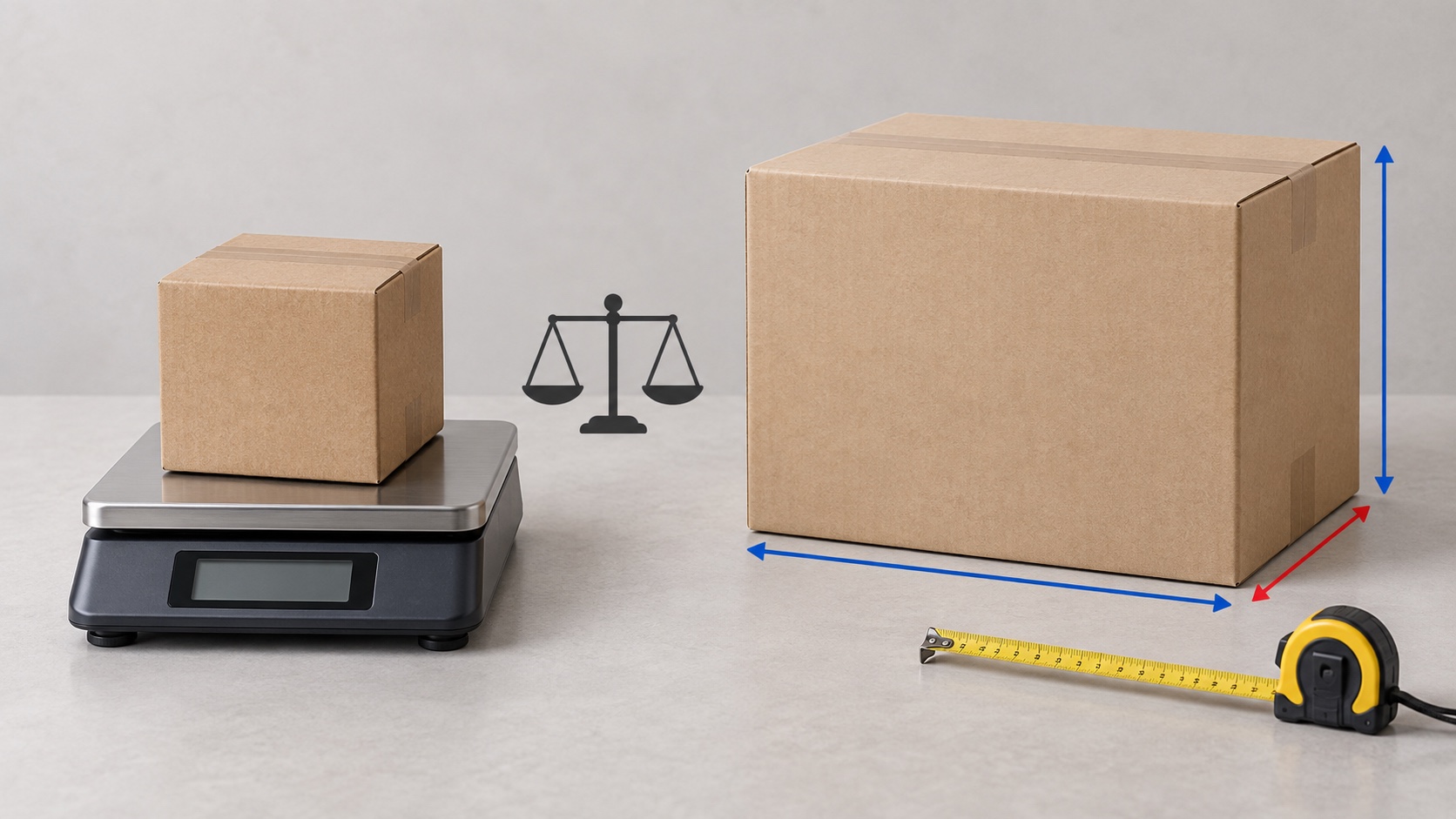
The rate card uses one volumetric-weight formula:
Volumetric weight (kg) = length × width × height (cm) ÷ 6000
The same formula does not produce the same chargeable-weight result for West and East Malaysia.
| Destination and route | Chargeable-weight logic on the 22 July 2026 rate card | Rounding unit |
|---|---|---|
| West Malaysia air | If the difference between volumetric and actual weight is no more than 20kg, use actual weight. If the difference exceeds 20kg, use (volumetric weight + actual weight) ÷ 2 | 0.5kg |
| East Malaysia air | Use the greater of actual and volumetric weight | 0.5kg |
| West Malaysia sea | Use the greater of actual and volumetric weight | 1kg |
| East Malaysia sea | Use the greater of actual and volumetric weight | 1kg |
The air-shipping rate card also lists common basic size limits: actual weight no more than 30kg, no single side longer than 100cm, and the sum of all three sides no more than 160cm. For sea shipping, check the small-parcel and oversized-parcel tiers as well. West Malaysia sea shipping treats a parcel as oversized when its actual weight exceeds 30kg or the sum of its three sides exceeds 180cm. For East Malaysia sea shipping, the chargeable weight of a consolidated small parcel must not exceed 30kg and the sum of its three sides must not exceed 180cm. The system’s size assessment still prevails.
The same carton could be charged as 6kg to West Malaysia and 10kg to East Malaysia
Suppose the final outer carton after warehouse consolidation measures 50 × 40 × 30cm and has an actual weight of 6kg:
- Its volumetric weight is
50 × 40 × 30 ÷ 6000 = 10kg. - For West Malaysia air shipping, the difference between volumetric and actual weight is 4kg, which does not exceed 20kg. Under the 22 July rate-card rule, the chargeable weight is therefore 6kg.
- For East Malaysia air shipping, West Malaysia sea shipping or East Malaysia sea shipping, the greater of actual and volumetric weight applies, so 10kg enters the corresponding rate tier.
This is only a worked example using the rate-card formula, not a quotation. The final dimensions after warehouse repacking, weight, cargo type, route and system rounding can all affect the checkout total.
Use the rate card for a budget, not an old price as a live quote
For a first-pass budget, the common general-cargo tiers on the 22 July rate card can help establish the likely range. All figures below are in renminbi. This is not the complete rate card and not a live October quotation:
| Common tier | 22 July 2026 baseline |
|---|---|
| West Malaysia economy air, general cargo | RMB 14 for the first 0.5kg, then RMB 11 per additional 0.5kg |
| West Malaysia economy sea | 1–10kg: RMB 12 for the first kg, then RMB 8 per additional kg; 11–29kg: RMB 8/kg; 30–500kg: RMB 7.50/kg plus RMB 60 per order |
| East Malaysia air, general cargo | 0–10kg: RMB 22/0.5kg; 11–30kg: RMB 14/0.5kg |
| East Malaysia sea | 1–10kg: RMB 20 for the first kg, then RMB 13 per additional kg; 11–29kg: RMB 12.55/kg; 30–500kg: RMB 10/kg plus RMB 60 per order |
West Malaysia also has express air, express sea and a sea green line limited to compliant food products. General and special cargo have different rates as well. Before paying, return to the complete 2026 Malaysia rate card to check the cargo type, full weight tier and current app quotation. Do not simply multiply one low figure in the table by the parcel weight.
A larger consolidated carton is not always cheaper; remove wasted volume
Start by sorting incoming purchases into three groups:
- Dense with a small outer box: Focus on total weight and the per-carton limits. There is no need to add products you do not need just to “fill” the carton.
- Light but bulky: For shoes in boxes, storage containers, puffy textiles and similar items, first ask whether the warehouse can remove unnecessary retail cartons or repack more closely without harming the products. Then use the new measurements.
- Fragile or restricted: For glass, ceramics, batteries, power banks, liquids, aerosols, food and similar goods, confirm the product category and accepted route first. Do not remove essential cushioning, seals or compliant packaging merely to save a few centimetres.
Combining two cartons can reduce volumetric weight only if it removes duplicated outer packaging and empty space. If the same total volume simply goes into one larger carton, or extra gaps are left to keep the contents tidy, the chargeable weight may not fall. Compliance and protection come before saving a few centimetres.
Treat the earliest warehouse check-in as your consolidation clock
From 1 October 2026, the Malaysia storage rules no longer provide the 90-day free-storage period described in older articles:
- Parcels receive 60 days of free storage after warehouse check-in.
- Outside the special period, parcels stored beyond 60 days are charged RMB 2 per parcel per day.
- From 15 October to 15 December 2026, Beijing time, parcels stored beyond 60 days are charged RMB 5 per parcel per day. This is the applicable rate during that period; it is not an additional RMB 5 on top of RMB 2.
- The rule that starts the disposal process after 120 days in storage remains unchanged.
This means a Double 11 consolidation plan should not focus only on when the last purchase might arrive. List the actual warehouse check-in date for every parcel and use the earliest one as your clock. Then compare two costs: the storage-fee risk of waiting longer and the extra first-weight charge or per-order surcharge from sending a second batch.
When the earliest parcel approaches 45 days in storage, review the plan again: calculate one shipment using everything that has arrived, then place products that have not shipped or are still on preorder in a separate batch. The 45-day point is a planning buffer, not a platform rule. Whether to split the shipment still depends on each batch’s chargeable weight, first-weight charge, surcharge and checkout quotation.

Leave weather room in November without turning the season into a delay guarantee
MET Malaysia’s long-range outlook updated on 4 September 2026 expects the monsoon transition to begin in October, with weak and variable winds and possible short periods of heavy rain and strong winds from afternoon to evening. Its long-term climate information says the northeast monsoon usually lasts from November to March, with heavier rainfall concentrated along the east coast of Peninsular Malaysia, western Sarawak and eastern Sabah.
This weather information can help you allow extra time, but it cannot tell you that a particular parcel will definitely be delayed, nor should weather conditions across East Malaysia be treated as uniform. Before payment and during delivery, check MET Malaysia’s live alerts for the destination state, and allow flexibility for warehouse intake, parcel consolidation, customs clearance and local delivery. Any estimated date shown on the page is for planning purposes only and should not be treated as a guaranteed delivery date.
Put these six items on one page before paying
- The warehouse’s final outer-carton length, width, height and actual weight.
- Whether the destination is West Malaysia, Sabah or Sarawak, and the routes actually available.
- Whether the products are general cargo, special cargo, food or prohibited/restricted goods.
- The chargeable weight, rounding unit and oversized-parcel surcharge for that route.
- The days each parcel has spent in storage, the storage fee shown on the page and the cost of splitting the shipment.
- The live shipping fee, delivery estimate, applied promotion and final amount shown at checkout.